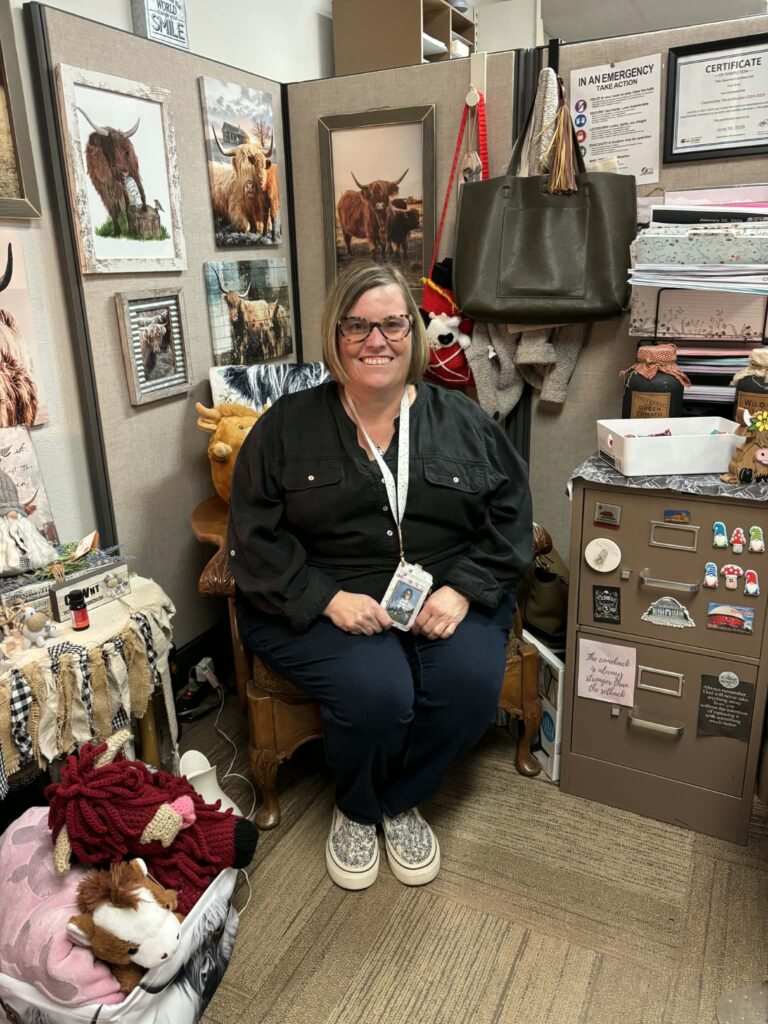
Celebrating Angela Mead’s 42-Year Legacy in Child Welfare

After 42 years of unwavering dedication to the well-being of children, youth, and families in Larimer County, Angela Mead is embarking on a new chapter in her life. Angela Mead’s career began as a volunteer in 1984, followed by earning her Master of Social Work from the University of Denver, and ultimately serving in key administrative leadership roles. Her professional journey reflects a deep and enduring belief in the power of community, collaboration, and family resilience. Over four decades of service, she played a pivotal role in advancing both organizational and philosophical shifts that have shaped child welfare practice in Larimer County and across Colorado.
“I think families overcome adversity and thrive better when they know they are connected to their community—when they have a community investing in their safety and well-being. It’s a beautiful thing, and it’s been incredible to see how that has evolved over the many years I’ve worked in child welfare,” Angela shared.
Angela’s early career provided a strong foundation in generalist child welfare practice. Her roles included emergency screener, intake and ongoing caseworker, forensic interviewer in complex sexual abuse cases, and a supervisor. In her later years, she transitioned into administrative leadership, where she provided oversight of multiple child welfare programs and strengthened community partnerships to better address the diverse needs of children, youth, and families involved in the system. This combination of frontline and administrative experience fueled her passion for innovation and led to the development of two transformative programs:
Family Assessment Intervention Program (FAIP): Modeled after the Homebuilders approach, this intensive, in-home program achieved an 85% success rate in safely keeping children in their homes, demonstrating the effectiveness of early, family-centered intervention in preventing out-of-home placement.
Harmony House: Born from a simple yet powerful idea, Angela partnered with the Executive Director and Board of Directors of Court-Appointed Special Advocates (CASA) to co-develop Harmony House—a warm, family-like visitation center in Larimer County. This innovative space reimagined parent-child parenting time and continues to serve families today.
Angela was also a driving force behind major organizational improvements that positioned Larimer County as a leader in state child welfare reform. Among the most significant initiatives she helped implement were:
Paired Teams: More than 20 years ago, Angela supported a critical practice shift that eliminated the separation between intake and ongoing casework, streamlining services under a single supervisor to improve continuity for families.
Differential Response and Signs of Safety: Larimer County was among the first five counties in Colorado to adopt Differential Response and the Signs of Safety practice framework, setting the standard and supporting other counties in implementation.
Trauma-Informed Care Practice Model: In partnership with Colorado State University’s Human Development and Family Studies program, Angela helped lead Larimer County Child Welfare’s transition to trauma-informed practice, including trauma assessments for children and youth and resilience assessments for adults. This work later expanded to other counties across the state.
Larimer County Child Fatality Review Team: Angela collaborated with local law enforcement, the Coroner’s Office, the Child Advocacy Center, and other human service agencies to establish a multidisciplinary team that reviews all child deaths in Larimer County.
Family Safety Forum: This initiative strengthened collaboration between Child Protective Services and law enforcement through operating agreements, joint training for caseworkers and detectives, and collaborative problem-solving efforts.
Given the pervasiveness of substance use and mental health disorders in child welfare, Angela strongly valued the practice shift toward integrating mental health and substance use treatment for adults involved in the system. She recognized that families impacted by these challenges require a comprehensive, coordinated approach to services. Throughout her career, much of her leadership and teaching focused on child welfare practice with families affected by substance use. This included her involvement in Colorado’s Drug Endangered Children initiative, as well as leading a similar community-based effort to develop strategies addressing the methamphetamine epidemic.
“I collaborated with subject matter experts across the state to develop and publish a book. I contributed Chapter 13, titled Methamphetamine Addiction: An Integrated Approach to Case Management Evaluation and Treatment. The chapter drew on what I learned from professionals in law enforcement, child welfare, and the drug and alcohol field and translated those best practices into a case management model for working with families involved in child welfare,” Angela explained.
Angela went on to design and facilitate numerous training courses for case workers that emphasized the value of an integrated approach to case management. She also focused her work on substance-exposed newborns, recognizing the importance of strong partnerships with local hospitals and a multidisciplinary approach to supporting infants and families. This work included early identification, mandated reporting, and the development of plans of safe care within both child welfare and medical settings. A key goal was supporting mothers during pregnancy and, when possible, diverting families from deeper involvement in the child welfare system. Angela partnered with hospitals to train case workers and medical staff on assessing substance-exposed infants, supporting families, and creating safe discharge plans.
Angela has often remarked that one of the most rewarding aspects of her career has been teaching and mentoring others in the child welfare field. She worked with the Child Welfare Training System and community partners to develop a wide range of training related to child abuse and neglect. Her audiences included case service aides, case workers, supervisors, and law enforcement officers. Angela also taught a child welfare course at the Colorado State University School of Social Work, where she shared her professional experience with students and actively recruited future professionals into the field.
“When you’ve been in the field a long time, mentoring others becomes critically important,” Angela reflected. “People entering this work are compassionate and driven to serve. It’s in their heart and soul. Their success depends on guidance and support from others who can teach them how to practice effectively. Training our workforce is essential,” she emphasized.
Near and dear to her heart was Angela’s work on several state-led initiatives aimed at strengthening child welfare practice across Colorado. These efforts included revamping the Child Welfare Training System, designing and implementing the statewide hotline, supporting the statewide implementation of Differential Response, and assisting counties in becoming more trauma-informed in their practice.
Angela recalls one of the most profound moments of her career from her time as an Intake Supervisor, when she was training a new intake caseworker on how to assess a child fatality. The case involved a six-year-old girl who survived a gunshot wound inflicted by her father while witnessing the homicide of her mother and siblings. Her father then died by suicide. In the aftermath of this tragedy, the child’s family and community came together to ensure her safety, well-being, and permanence. She was ultimately adopted by her aunt and uncle. This case also marked the first time Larimer County facilitated a Family Group Decision Making meeting to plan for a child’s safety and permanency.
“About ten years after the case closed, she and her aunt returned to the community and reached out to some of us who had been involved in her case to express their gratitude and to let us know she was thriving and doing very well. That experience taught me so much—it speaks to the power of family, the power of community, and the resilience children can show in the face of unimaginable adversity,” Angela reflected.
This experience led Angela to serve on the State Child Fatality Review Team for four years and inspired her to develop a training course for supervisors titled Sleep Tight, the Kids Are Alright: Supervisory Practice to Prevent Serious Harm. The course is offered through the Child Welfare Training System for supervisors and lead workers across the state.
While her retirement plans include much-deserved self-care, rest, relaxation, and travel, Angela hopes to remain engaged through teaching, volunteering, or serving in an advisory role to continue supporting others in this vital work.
In closing, Angela would like to share some personal advice to those professionals entering the field of child welfare:
“Pursue what you believe in with steadfast conviction. Be a voice for those who are underprivileged, and work toward equality. Remain humble, hold onto hope, and believe in the power of restoration.”